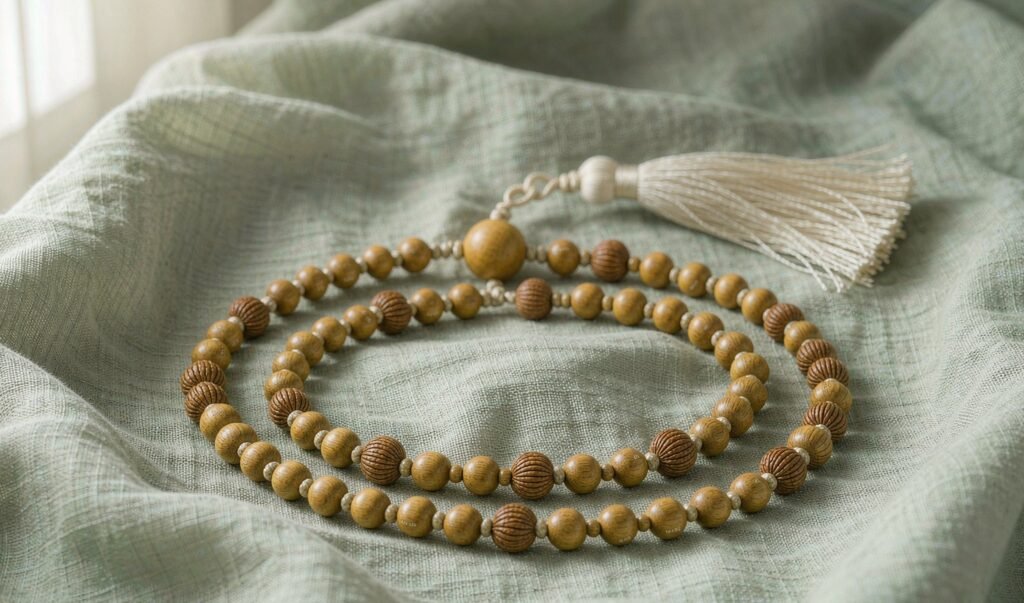
The number 108 appears in several South and East Asian contemplative traditions as a count used for repetition and recitation. Different communities attach different symbolic meanings to it, and the strand has long been used as a tactile aid for keeping count during practice. We describe this as cultural history, not as a promised personal effect, because the object itself is a tool and an accessory.
Strands of repeated beads have been made for centuries across many regions, using wood, seed, bone, and stone depending on what was local. The consistent count gave users a reliable way to track a long repetition without losing place, and the form spread along trade and teaching routes.
A full strand is worked one bead at a time, usually moving in a single direction. A larger bead, often called the guru bead, marks the turn so the count does not run off the end. The practice is personal and varies by tradition, so there is no single correct routine for everyone who picks one up.
Most users rest the strand over the fingers of one hand so it is easy to advance bead by bead.
A traditional strand spaces beads on a cord with small knots between them so the beads do not rub. The marker bead and a tassel or end bead finish the piece. Modern versions may skip the knots for a smoother look, but the count stays the same.
A 108-bead strand is long, so it is often worn wrapped several times around the wrist or as a necklace. As an accessory it reads as a layered, textured piece. If you wear it daily, treat it like any other bead jewelry and keep it away from prolonged water and rough surfaces.
Long strands collect more cord strain at the knots, so check the cord where it passes the marker bead every few months. Store the piece loosely coiled rather than knotted tight, and keep it in a pouch when not worn so the tassel stays neat.
Because the form carries meaning for many communities, it is worth learning the basics before wearing one, even if you approach it as jewelry. Knowing the background helps you choose a piece that fits how you intend to use it.
When you choose a strand, check that the beads are evenly sized and that the cord between them is even and untwisted. A comfortable length for wearing is one that wraps your wrist the number of times you like without pulling. Decide first whether you want it for practice, for wear, or for both, since that choice changes which material and finish suit you best.
A full mala is heavier and longer than a wrist strand, so it asks for a bit more care in how you set it down. Lay it flat rather than draping it over a hook, which can stretch the cord at one point, and keep the tassel from catching on zippers. The extra length also means more cord to check, so fold it loosely when you store it.
Crystals, gemstones, and wood beads from YouZmyshop are sold as decorative and cultural objects. They are not intended to diagnose, treat, cure, or prevent any disease or health condition. Cultural and historical references describe traditions, not promised effects.