Mohs hardness is a scale from 1 to 10 that ranks how easily one mineral scratches another. It is a relative order, not a linear measure, but it is a useful rule of thumb for daily wear. A harder stone scratches a softer one; a softer stone picks up marks from anything harder.
Quartz-family beads such as clear quartz, amethyst, rose quartz, smoky quartz, citrine, agate, and carnelian sit around 6.5 to 7 on the scale, so they resist everyday scratches well. Lapis lazuli and turquoise are softer, roughly 5 to 6, and they need a bit more care. This is why a turquoise or lapis bead can show wear sooner if it rubs against something harder.
Softer stones can pick up fine scratches from dust, which often contains quartz particles, or from metal findings that are harder than they are. A bead that sits next to a steel clasp or a hard spacer can develop small marks at the contact points over time.
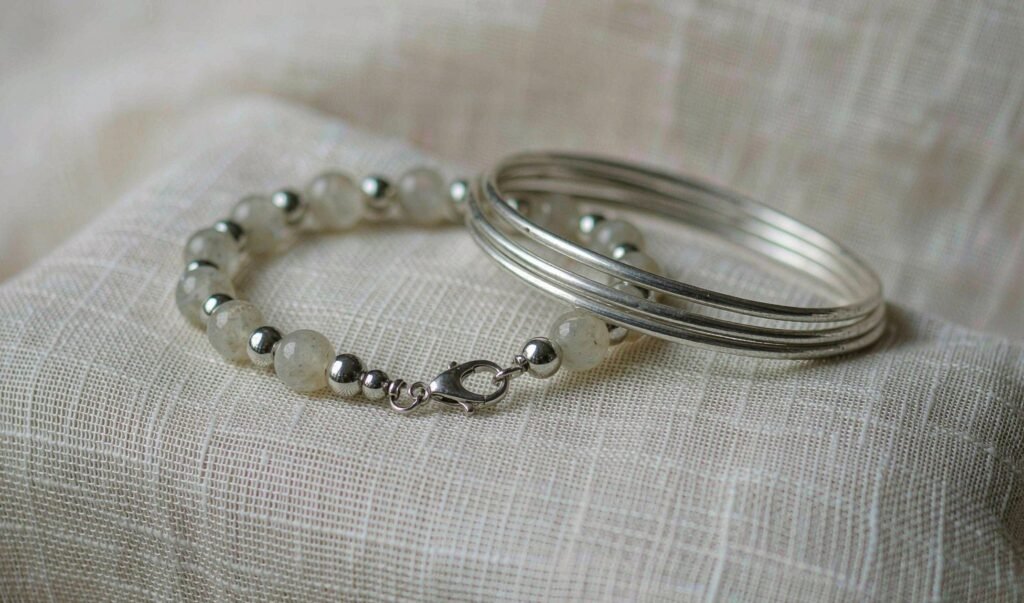
Metal clasps and spacers are commonly harder than the beads they touch, so a little planning helps. Keep hard quartz away from softer stones in the same strand, or place a soft bead so it does not knock directly against a metal end. Wiping the piece after wear and storing it so beads do not rub against each other reduces most contact wear.
Hardness is about scratching, not breaking. Even a 7 on the scale can chip if it takes a sharp knock on a corner or an already thin edge. A bead with a visible surface crack is more likely to fail, so it is worth setting aside rather than wearing daily.
Hardness also matters for the stringing cord. A rough or chipped hole on any bead, hard or soft, can cut the cord over time, so hole quality is part of wear life regardless of the stone’s hardness. When you restring, a smooth hole protects the string better than a pretty but sharp one.
If you wear a quartz strand and a turquoise strand together, expect the turquoise to show wear first. That is normal and not a defect; it just means the softer piece benefits from the gentler habits described in the care articles. Matching hardness in one strand keeps wear even across the beads.
A bead that feels unusually light for its size can be a sign of a denser imitation or a hollow copy, though weight alone is rarely proof. As with the other checks here, use it as one signal among several rather than a single verdict.
A practical habit is to put the bracelet on last and take it off first when you dress, away from zippers and buckles. That single routine avoids most of the knocks and scrapes new owners see, and it takes no special products.
A useful mental anchor is that most quartz beads sit near the top of the common bead range at about 7, while turquoise and lapis sit a step lower at about 5 to 6. Holding that small gap in mind explains most everyday wear differences and tells you which piece deserves the gentler habits.
When you are not wearing a piece, lay it flat rather than hanging it by the cord, and keep beads from knocking against harder objects in the same drawer. Simple storage is part of wear life, because slow contact wear adds up far more than the occasional knock.
Crystals, gemstones, and wood beads from YouZmyshop are sold as decorative and cultural objects. They are not intended to diagnose, treat, cure, or prevent any disease or health condition. Cultural and historical references describe traditions, not promised effects.