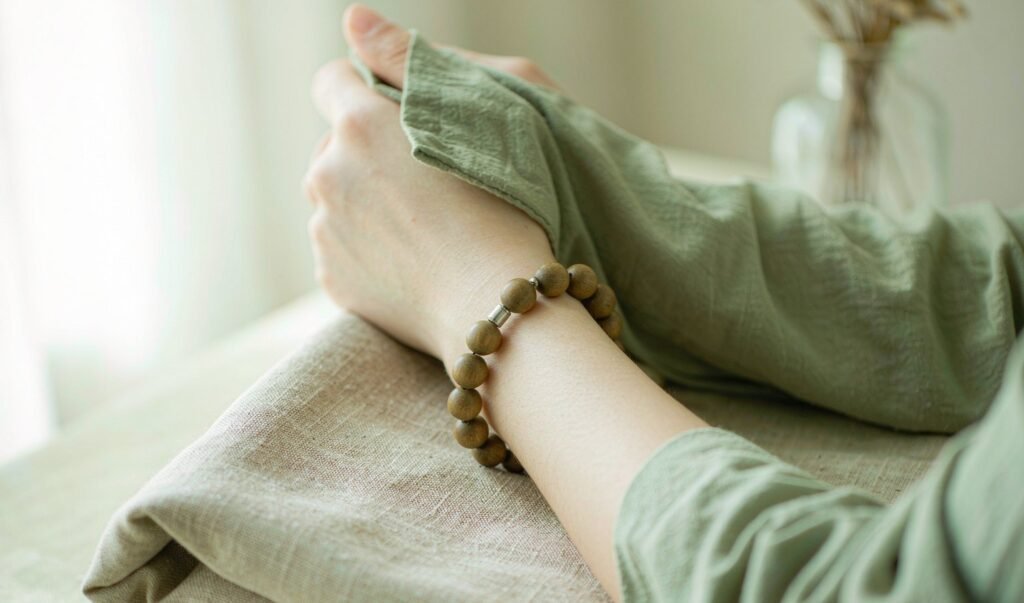
Different communities have different habits about which wrist to use, and none of them is a universal requirement. This is a matter of custom and personal preference, not a standard everyone must follow, so the right answer for you is the one that fits your day.
In some South Asian customs the right hand is treated as the active, preferred hand for many tasks, while in parts of East Asian etiquette the left or right may be favored depending on context and occasion. Mala strands, when worn, are often placed to keep the marker bead oriented and the strand comfortable. These are descriptive traditions, not promises attached to the object, and they vary even within a single region.
Most people today choose a wrist for pure practicality. Many wear the bracelet on their non-dominant wrist so it is less in the way while they work or write. Others match a watch, wearing the bracelet opposite the watch wrist so the two do not compete or scratch.
For daily wear, pick the wrist where the bracelet sits securely and does not bang against surfaces or a desk edge. If a strand has a fragile cord, the less active wrist is the safer choice. Beyond comfort and safety, wear it wherever you like.
You may hear firm rules about one side being correct. For an accessory, those rules are custom, not law. If a family tradition suggests a side, follow it because it means something to you; if none does, let comfort decide.
Whichever wrist you choose, the same care rules apply: keep the piece away from prolonged water and store it in its pouch. Comfort and longevity matter more than which side the bracelet happens to be on.
The most satisfying choice is the one you will actually wear. Try the piece on both wrists at home for a day each, then keep it where it feels least noticed and most natural.
If a relative expects you to wear a bracelet on a certain side, a short explanation that you chose comfort goes a long way, and you can still honor the custom on special days. The object is flexible enough to satisfy both; what matters is that the choice feels intentional to you rather than accidental.
When you wear a long strand, the same wrist comfort rule applies, but the extra length means it can swing against surfaces more often. Many wearers coil it so the end tucks in, which keeps it from catching. Whichever wrist you choose, secure the strand so it does not dangle into your work, and the custom question becomes a non issue.
Before you commit, wear the bracelet on each wrist for an hour at home. Notice which side you stop noticing first; that is usually the better choice. The test takes almost no time and removes guesswork, so the piece you keep is the one that disappears into your day.
Crystals, gemstones, and wood beads from YouZmyshop are sold as decorative and cultural objects. They are not intended to diagnose, treat, cure, or prevent any disease or health condition. Cultural and historical references describe traditions, not promised effects.