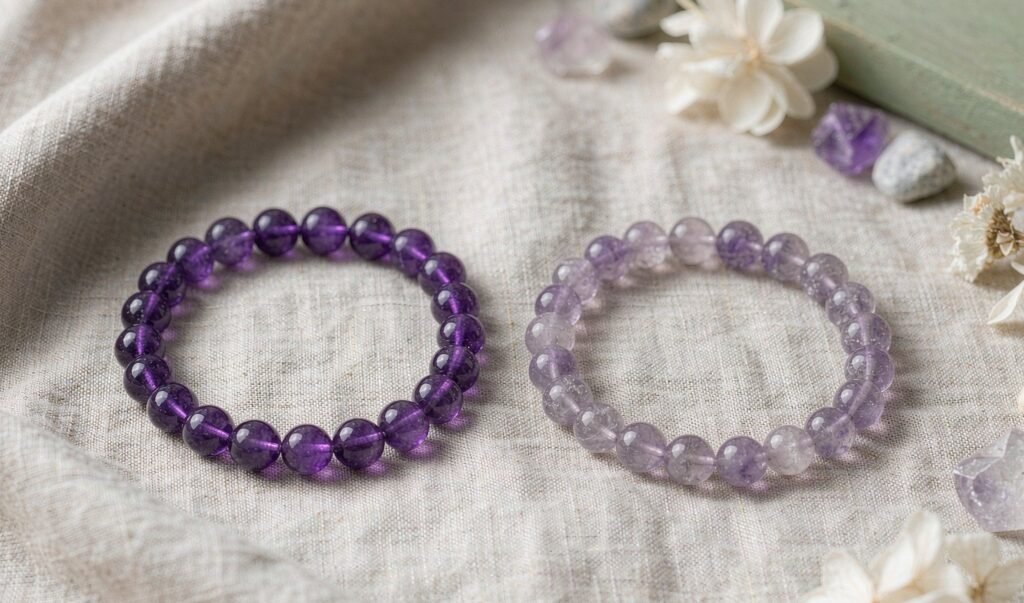
Color is the first thing buyers notice, and saturation drives much of the price. A deep, even amethyst purple or a rich turquoise blue usually costs more than a pale, washed-out version of the same stone. Within one species, stronger and more even color tends to command more.
For stones where a clear look is wanted, fewer visible inclusions means a higher grade and a higher price. For stones where inclusions are part of the charm, the rule is about evenness and stability rather than total clarity. Either way, a clean, sound bead costs more than one with a surface crack.
A strand where every bead matches in size and color takes more sorting than a loose mix, so matched strands cost more. Larger individual beads also use more material, which adds up across a whole bracelet.
Some colors are simply less common in nature, or come from fewer sources, and that scarcity shows in the price. Natural citrine, for example, is less common than the heated version, and that difference is reflected in what sellers ask.
Some colors come from treatment, such as amethyst heated into citrine, and treated material is common and accepted. The point for price is simply that natural color of the same look usually costs more, so knowing which you are looking at explains part of the difference. A plain listing that names the material is easier to judge than a vague one.
Where a stone comes from can matter to price, but for most beads the bigger, visible factors are color, clarity, and uniformity. Origin is a supporting detail rather than the whole story, and you can make a fair judgment from the visible grade alone.
Even shaping, a clean hole, and a consistent polish all take time and skill, and better finish raises the price modestly. A strand that looks finished is usually priced for the extra sorting and shaping behind it.
Putting it together, two bracelets sold as the same material can differ because of color grade, clarity, uniformity, bead size, and source. Reading those factors is how you judge whether a price fits the piece, rather than assuming one name means one fixed value.
A strand that looks even took sorting time: someone matched bead to bead so the line reads clean. That quiet labor is part of the price, and it is why two strands of the same name can sit at different points. Looking for evenness is looking at where the money went.
Rather than chase the lowest price, compare two or three strands of the same material and note where they differ in color, clarity, and match. The one that fits your eye at a fair price is the right buy, and the grade labels now tell you why.
When you stand in front of two strands, the grade is no longer abstract: it is the color you see, the clarity you see, and the evenness you see. Pick the one whose visible grade matches the price, and you have done the same work a label would have done for you.
Crystals, gemstones, and wood beads from YouZmyshop are sold as decorative and cultural objects. They are not intended to diagnose, treat, cure, or prevent any disease or health condition. Cultural and historical references describe traditions, not promised effects.