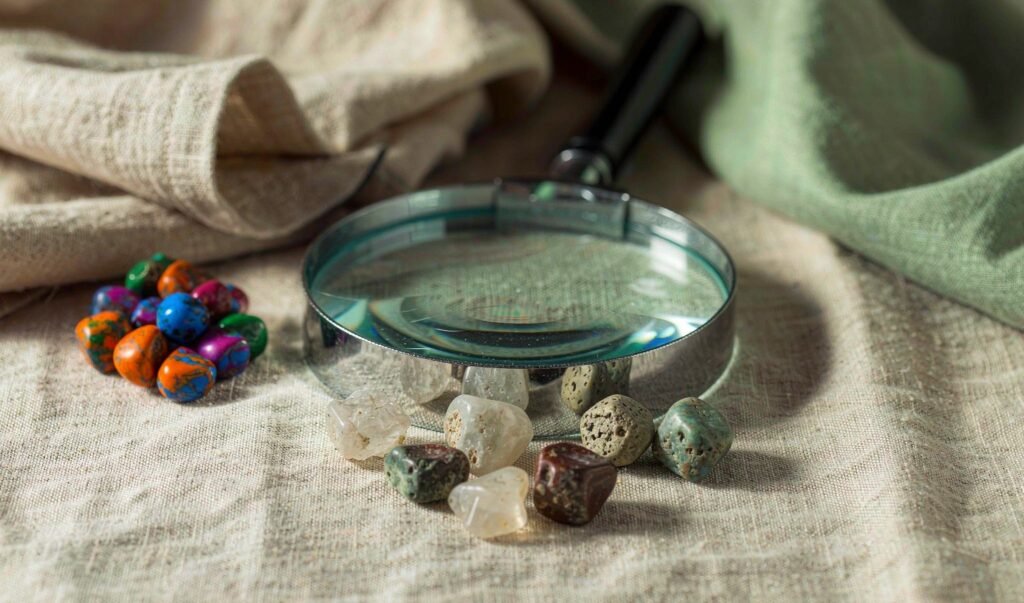
The drill hole is often the most honest part of a bead. On a natural stone the edge is usually slightly uneven and may show the stone’s true color inside the bore. A dyed bead often shows a darker ring right at the hole, where color pooled during treatment. A glass or resin copy can have a too-perfect, glassy edge with no grain at all, because it was cast in a mold.
Dye follows paths of least resistance, so on a dyed stone the color is often darker along fractures and along the hole, and lighter in the solid body. Natural color usually sits more evenly through the stone, or shows gentle zoning from the crystal’s growth rather than sharp dark lines in cracks. If the darkest color is exactly where the stone is thinnest, be curious.
A small loupe or a phone macro shot helps. Tiny round air bubbles trapped inside are a strong sign of glass or cast resin. Natural stone can have mineral specks and small fractures, but not perfect spheres lined up in rows. Bubbles are one of the clearest tells you can find at home.
If every bead in a strand is exactly the same shade with no variation, pause. A printed, uniform look can point to dye or a synthetic body. That is not proof on its own, but it is a reason to check the surface and the hole more closely.
Lab-grown quartz is chemically the same as natural quartz, so simple visual checks can miss it. Synthetic material is often very clean and may show curved growth lines rather than the angular zoning of natural crystal. Definitive identification of a synthetic usually needs a lab or specific instruments, so for higher-value pieces it is reasonable to ask how the seller describes the origin.
Glass copies feel different in the hand: often a touch heavier or deader than the stone they imitate, and they warm up faster to the touch. They also show a shell-like fracture if chipped, while crystalline quartz breaks differently. These are clues, not proof, but together they build a useful read.
Hold a bead to a light source and look at how color passes through. Natural translucent stone usually shows gentle, uneven transmission, while a dyed or glass copy may show a flat, even glow with no inner life. This is a supporting clue, not proof, but it pairs well with the hole and bubble checks above.
If a strand is offered at a price far below the usual range for a named material, pause. Very low prices for a rare color are a common signal that the material is not what the listing claims. Compare against several listings and notice whether the seller names the material plainly rather than with vague marketing words.
The fastest way to learn is to handle a few known pieces and compare. After you have felt real amethyst, real turquoise, and a known glass copy, later comparisons get much easier. Your own eyes and hands stay the best tools you have.
Genuine polished stone usually has a luster that fits its type, whether glassy for quartz or waxy for chalcedony. A copy may look too glassy all over, or too flat and plastic-like. Luster alone is not proof, but an odd shine for the claimed material is a reason to keep checking the other clues.
Crystals, gemstones, and wood beads from YouZmyshop are sold as decorative and cultural objects. They are not intended to diagnose, treat, cure, or prevent any disease or health condition. Cultural and historical references describe traditions, not promised effects.