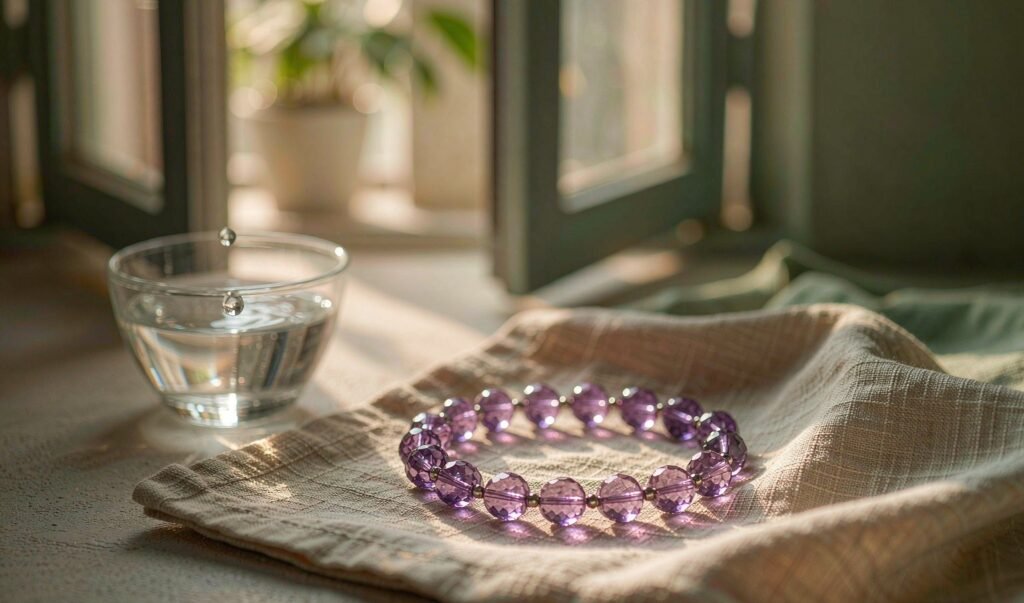
Some beads are porous or treated and can change when they sit in liquid. Others are stable but still dislike long soaking because of their settings or cords. A short rinse is rarely a problem for hard quartz, but prolonged submersion is a different case.
Turquoise is porous and can absorb oils, perfumes, and colored liquids, which may shift its surface tone. Lapis lazuli can be sensitive to acids and long soaking as well. For these softer stones, wipe with a dry or barely damp cloth rather than washing, and keep them away from perfume, lotion, and hair spray.
Long, strong direct sun can lighten some stones. Amethyst in particular may pale with extended exposure to bright sunlight, so storing it out of a sunny window helps keep its color. Most quartz is stable, but steady shade is the safe default for any colored stone.
Pool water carries chlorine, and hot springs carry dissolved minerals and heat, both of which are poor company for beads. Remove the bracelet before swimming, soaking in a spring, or sitting in a sauna. If it does get wet, pat it dry and let it air at room temperature rather than next to a heater.
For hard quartz, normal skin moisture is fine; just wipe the beads after a heavy workout. For softer or porous stones, sweat plus friction is more of a factor, so a rest day during intense exercise is the kinder choice. As always, the cord likes dry conditions more than wet.
Beyond the stone, the cord dislikes long water. Stretch cord in particular loses spring faster when it stays wet, so a bracelet that gets soaked should be dried and, if worn often, checked for fray. The stone may be fine while the string is the part that ages.
Quick hand washing is usually fine for hard quartz; just dry the bracelet afterward. For softer or porous stones, it is kinder to slip the bracelet off before washing and put it back on after. A few seconds of habit protects the piece far more than any product.
Do wipe with a dry cloth, store dry, and keep pieces out of long sun. Do not wear them in pools or springs, do not spray perfume onto the beads, and do not leave them on a sunny sill. These few rules cover most of what shortens a crystal bracelet’s good looks.
Rapid temperature change can strain some stones and their settings, so moving from a cold outdoor day straight to a hot car vent is worth avoiding. Steady, moderate conditions suit beads better than quick swings, much like they suit wood.
If a bracelet ends up soaked by accident, do not panic and do not bake it dry. Pat it with a towel, lay it flat on a cloth, and leave it at room temperature until the cord feels dry to the touch. A slow dry-out avoids the cracking that heat would cause.
After wearing, a fast wipe with a dry soft cloth removes skin oils and dust before they sit on the surface. This small step takes seconds and is the single habit that keeps both the stone and the cord in better shape between deeper cleans.
Crystals, gemstones, and wood beads from YouZmyshop are sold as decorative and cultural objects. They are not intended to diagnose, treat, cure, or prevent any disease or health condition. Cultural and historical references describe traditions, not promised effects.